



%202.svg)


Key Takeaways
- Offshore QA is cost-effective but slows agile teams through time-zone lag.
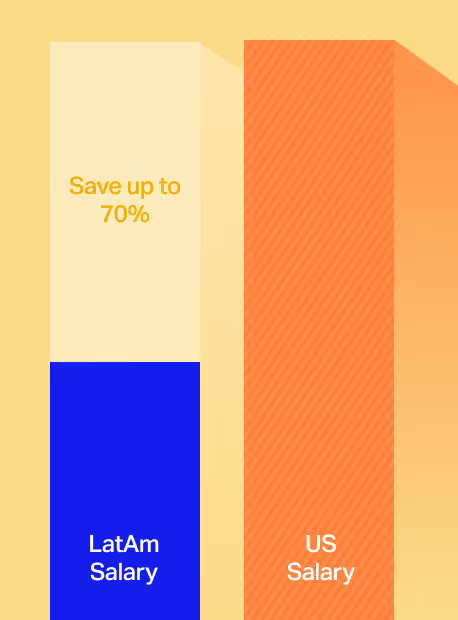
- Nearshore QA engineers in Latin America deliver real-time collaboration and continuity at 40–70% lower cost than U.S. hires.
- Building QA capability in-house with nearshore talent improves velocity, product knowledge, and long-term quality ownership.
You've decided to hire a QA engineer internationally. The budget for a US hire isn't there, and you need someone who can catch bugs before they reach production.
Now the question is: where?
India and the Philippines offer the deepest cost savings. Latin America costs a bit more but still runs generally 30–60% below US rates.
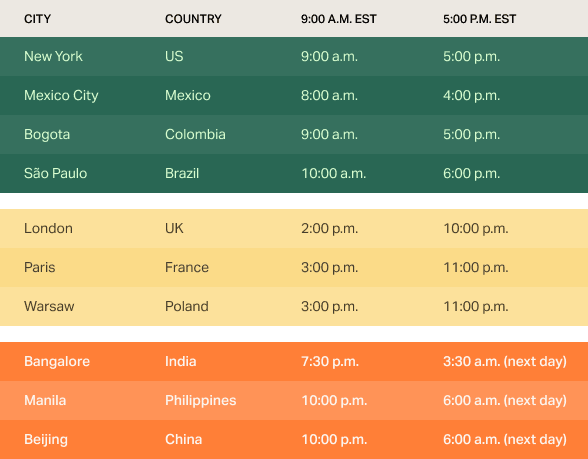
But here's what that cost difference doesn't show: A QA engineer in Manila or Bangalore works while your team sleeps. A QA engineer in Bogotá or Buenos Aires works your hours. That changes how your testing cycles actually play out and how fast you can ship.
For many teams, hiring QA testers or engineers in Latin America is often the better choice.
Why Do Teams Hire Offshore QA Testers and Engineers?
Hiring QA engineers in India, the Philippines, or other distant regions offers the deepest cost savings—often 50–70% less than US salaries—but the 10–13 hour time zone gap creates async delays that turn real-time collaboration into multi-day cycles.
When you're trying to control costs, hiring a QA engineer in India or the Philippines makes financial sense on paper. Salaries are significantly lower than US rates, and the talent pool is deep with experienced manual testers and automation engineers.
For companies with mature products and predictable release cycles, it can work. Regression testing runs overnight, reports arrive by morning, and you've added full-time QA capability without the US price tag.
The challenge of offshore QA hiring
For teams shipping frequently, the time zone challenges become impossible to ignore.
Your developer commits a fix at 10 a.m. Pacific. Your QA engineer in Manila sees it when they start their day—which is your 6 p.m. You see their feedback the next morning. By then, your team has context-switched twice, and what should have been a same-day verification stretches into a two-day cycle.
One CTO we spoke with described it this way:
Our senior QA in Sri Lanka is excellent, but we don't get enough overlap to keep quality and throughput high. We often ship without her. The fix is obvious: a tester who is online when we are.
It's not about talent. The QA engineers are skilled. It's just that when your team is awake, theirs is asleep. That async rhythm means slower feedback loops. And when QA becomes a bottleneck, developers start making calls without full sign-off just to keep things moving.
What Makes Latin America Different for Hiring QA Testers and Engineers?
Hiring QA engineers in Latin America costs 30–70% less than US hiring while maintaining overlapping time zones. This eliminates the async delays that slow offshore QA without sacrificing the cost savings that make international hiring attractive.
With nearshore hiring in Latin America you get full-day overlap with your developers in the US, English fluency, and cultural alignment, without the six-figure US salary requirements.
A QA tester in Bogotá or Buenos Aires can hop on your 10 a.m. standup, test a new feature by 2 p.m., flag a defect, and confirm the fix before your end-of-day deploy.
The entire feedback loop happens in one workday, not two.
For teams that have tried far-offshore hiring and felt the velocity drag, this is often the unlock.
You're not choosing between collaboration and cost savings. You're getting both.
The QA talent pool in Latin America spans manual testers through senior automation engineers and SDETs. You can hire someone for exploratory testing today and scale into CI/CD automation as your product matures—all with team members who work your hours and build deep product knowledge because they're participating in real time, not catching up overnight.
This is why more US tech companies are shifting their hiring strategy: they're still building QA in-house with their own full-time employees, but they're staffing those roles in Latin America instead of competing for expensive US talent.
Final Thoughts
Every engineering leader knows this reality: bugs caught early cost pennies to fix, while bugs caught in production cost dollars.
The IBM System Science Institute found that defects discovered during design are roughly six times cheaper to resolve than those caught during implementation. By the time a bug reaches production, you're looking at 15–100× the cost. That multiplier isn't just about engineering hours. It's customer trust, support tickets, and revenue impact.
That's why the QA hiring decision matters so much.
Offshore hiring in Asia offers the deepest cost savings, but those savings evaporate when time zone lag doubles your defect resolution cycle and forces you to ship without QA sign-off.
Nearshore hiring in Latin America gives you cost savings—30–70% less than US rates—while preserving the real-time collaboration that keeps your release velocity high. Your QA engineers work your hours, join your standups, and build the product knowledge that comes from participating daily, not reviewing work overnight.
If you're ready to explore hiring a top QA engineer or tester in Latin America, Near connects US companies with pre-vetted QA talent across the region. We handle the sourcing and initial screening so you only interview candidates who match your technical requirements and communication standards. Most of our clients make a hire within 21 days.
Schedule a free, no-commitment consultation call. There's no fee to interview candidates, and you only pay when you find the right fit.
Frequently Asked Question
Do time zones really matter that much for QA?
Yes. Time zone overlap determines whether your QA process accelerates or bottlenecks your release velocity. Offshore QA engineers in Asia work while your team sleeps, turning same-day fixes into multi-day cycles. Nearshore QA testers and engineers in Latin America collaborate in real time during your business hours, keeping defect resolution inside a single sprint instead of stretching across multiple days.
Is it better to hire your own QA tester or outsource QA testing?
It depends on what you're optimizing for. Outsourcing QA to an agency provides fast, flexible coverage without long-term commitment, but you sacrifice product knowledge since testers rotate between multiple clients.
Hiring your own QA tester—whether in the US or Latin America—gives you dedicated expertise that compounds over time as they learn your codebase, users, and edge cases. For a detailed comparison of both models, see our guide on whether to outsource or hire QA testers.
What's the difference between a QA tester and a QA engineer?
A QA tester (or manual QA engineer) focuses on exploratory and manual testing: walking through user flows, reproducing bugs, and validating that features work as expected.
A QA engineer (often called an automation engineer or SDET) writes automated test scripts, builds testing frameworks, and integrates tests into CI/CD pipelines.
Most teams need both: manual QA for human judgment and edge case discovery, and automation engineers for scalable, repeatable test coverage. When hiring, clarify whether you need manual testing, test automation, or both.
Where can I learn more about QA outsourcing options?
For a look at QA outsourcing providers and how to evaluate them, read our guides on choosing a QA testing services company and comparing QA outsourcing service providers.


.avif)







%203.svg)
.avif)





%20(1).avif)

%20(1).png)
