%203.svg)
Key Takeaways
- The global offshore software development market reached $178.32 billion in 2025 and is on track for $204.32 billion in 2026, a 14.6% compound annual growth rate, according to The Business Research Company's Offshore Software Development Global Market Report 2026.
- Cost is no longer the single reason companies send software work outside their own team: 70% of executives called it a primary driver in Deloitte's 2020 Global Outsourcing Survey, and by its 2024 edition Deloitte ranked skilled talent and agility alongside cost as the key drivers.
- Offshore developer rates run from roughly $20–$45 an hour in Asia to $80–$150 in the United States and Canada, per market.us's October 2024 rate roundup, while hiring a full-time software engineer in Latin America runs $36K–$108K a year against $100K–$238K for the US equivalent, according to Hire With Near's salary benchmarks.
The most-cited offshore software development statistic right now is the size of the market itself: it reached $178.32 billion in 2025, according to The Business Research Company's 2026 report. It does what most figures online don't: it names a source and a year. Most carry neither, and that is the whole problem.
After more than a decade writing for technical audiences, the test I apply before repeating a statistic is simple: name the source, check the year. You're asked to justify an offshore engineering decision to a CFO or a board, you go looking for a number, and every version traces back to one blog quoting another. Cite one in a board deck and that missing source is the first thing someone challenges.
In this article, you'll find 11 offshore software development statistics with a named source and a year. You'll also find current developer rates by region and what it costs to hire software engineers in Latin America compared to equivalent US hires.
How Big Is the Offshore Software Development Market?
The offshore software development market size is $204.32 billion in 2026, up from $178.32 billion in 2025, a compound annual growth rate (CAGR) of 14.6%, according to The Business Research Company's Offshore Software Development Global Market Report 2026.
The same report, published in July 2026, puts the market at $347.99 billion by 2030 at a 14.2% CAGR.
The growth rate matters more than the absolute number. A market compounding at close to 15% a year is one where last year's figures date quickly, which is exactly why an undated statistic is a liability.
Regions that hold the largest share of the offshore development market
North America held more than 38.5% of the global offshore software development market in 2023, the largest single regional share, according to market.us's October 2024 report.
The share tracks where the buyers are. US and Canadian companies commission the largest single share of offshore engineering worldwide, and they're the ones moving fastest toward regions within their own working day.
Latin America's own software economy is growing alongside that demand. Grand View Research put the region's enterprise software market at $14.1 billion in 2024, with a projected 12.7% CAGR taking it to $28.4 billion by 2030.
Local growth is part of why the region works as a nearshore outsourcing hub for US teams: proximity, working-hour overlap, and a deepening local engineering market.
Regions that supply the most offshore developers
Asia remains one of the deepest supply bases for offshore developers, with India, the Philippines, and Malaysia offering competitive rates and large IT talent pools.
More than 180 million developers now build on GitHub, with over 36 million joining in 2025 alone, according to GitHub's Octoverse 2025 report, published in October 2025.
Latin America is where the growth curve is steepest relative to size. Octoverse 2025 counts 6.89 million developers in Brazil, now the world's fourth-largest developer community, with Brazil alone adding 3.2 million net new developers between 2024 and 2025, driven by remote hiring from US and EU firms and its fintech startup density. Mexico and Argentina round out the region's other hotspots for software development.
That combination, competitive rates and real technical depth, is why more US companies now hire Latin American developers directly instead of contracting an offshore vendor.
11 Offshore Software Development Statistics You Should Know in 2026
Offshore software development is now a standard part of how US companies staff engineering work. The eleven numbers below are the ones worth quoting, and each one carries its source and that source's publication year. Several break the picture down by country and by year, so you can cite the level of detail you need.
1. 80% of executives plan to maintain or increase their outsourcing investment
Deloitte's 2024 Global Outsourcing Survey, which polled more than 500 executives worldwide, found that 80% of them plan to maintain or increase their investment in third-party outsourcing.
The figure covers outsourcing in general, and software development is one slice of it. The direction is the useful part: among executives already running third-party delivery, the large majority plan to hold steady or invest more.
2. Skilled talent and agility now rank alongside cost as reasons to outsource
Deloitte's 2020 Global Outsourcing Survey found 70% of executives named cost a primary reason for outsourcing. By its 2022 edition, Deloitte reported that cost had been overshadowed by access to new capabilities and skills, and its 2024 edition lists skilled talent and agility alongside cost as the key drivers.
Independent data points to the same trend: ManpowerGroup's 2026 US Talent Shortage Survey found 69% of US employers struggling to find the skilled talent they need, compared to 72% of employers worldwide.
It matches what Hire With Near's engineering recruiters hear from US hiring managers: budget sets the ceiling, but availability sets the timeline. Our client success stories show what happens when both get solved at once.
3. Large enterprises hold 53.2% of the offshore development market
Large enterprises accounted for more than 53.2% of the offshore software development market in 2023, according to market.us's October 2024 report.
Big companies still commission most offshore engineering, which tells you the model is mature. For smaller companies, that maturity is the opening: the same vetted talent and delivery models are available to a 40-person startup, and outsourced software development for startups no longer means accepting whatever an agency has on the bench.
Enterprise software work follows the same pattern, including ERP systems like Odoo, where companies bring in specialists rather than retraining an internal team. It's also why IT and tech recruiting in Latin America has grown into its own category.
4. 76% of executives say their IT services are delivered through third parties
In Deloitte's 2022 Global Outsourcing Survey, 76% of executives said their IT services were delivered through third-party models, and 52% said IT functions are outsourced specifically.
Read those two figures together and the pattern is clear: at most companies, at least some IT delivery already runs through an outside provider. For most teams, the practical question is which model fits which kind of work.
5. Cloud data management services are forecast to reach $141.2 billion by 2027
MarketsandMarkets projected in April 2023 that the cloud-based data management services market would grow from $34.0 billion in 2022 to $141.2 billion by 2027, a 32.9% compound annual growth rate.
One clarification, because this figure circulates as an offshore number: it measures the cloud data management services market as a whole, not the share of it delivered offshore. Read it as evidence of where cloud spending is heading.
Cloud work is also where the hiring demand concentrates. Companies moving infrastructure or data platforms tend to look for cloud developers first, and nearshore SaaS recruiting has grown on the back of the same trend.
6. Nearshoring could add $78 billion a year to Latin American exports
The Inter-American Development Bank estimated in 2022 that nearshoring could add $78 billion a year to Latin American and Caribbean exports, made up of $64 billion in goods and $14 billion in services.
Nearshore outsourcing shows up in engineering hiring first. Hire With Near's 2026 State of LatAm Hiring Report analyzed 2,000+ placements made at US companies between October 2024 and October 2025. It found that demand for software engineers grew 250% year over year, moving the role from 18th to 6th most-filled.
The Latin American software industry is growing with it, including specialist pools in artificial intelligence, blockchain, and cloud computing.
If you're weighing the region for the first time, our guide to hiring remotely in Latin America covers the models, and outsourcing software development to smaller markets like Costa Rica works on the same logic.
7. The BFSI sector accounted for 24.3% of offshore development in 2023
Market.us's October 2024 offshore software development report put banking, financial services, and insurance at more than 24.3% of the market in 2023, the largest single vertical.
BFSI carries the strictest security, audit, and compliance requirements of any commercial sector. The fact that the most compliance-heavy vertical is also the largest offshore buyer tells you the model can be run inside serious regulatory constraints.
8. 83% of executives are using AI in their outsourced services
Deloitte's 2024 Global Outsourcing Survey found 83% of executives are using AI as part of their outsourced services.
For anyone evaluating a partner in 2026, that number sets the baseline question. Ask how AI is used in their delivery, who reviews the output, and what happens to your code and data when AI is part of the process.
9. 70% of executives have pulled some outsourced work back in-house
Deloitte's 2024 Global Outsourcing Survey found 70% of executives have selectively insourced scope that was previously held by a third party over the last five years.
This is the honest counterweight to stat #1. Companies keep investing in third-party delivery and they keep taking pieces of it back, usually the work that sits closest to the product.
It's a useful correction to a few of the common misconceptions about offshore development. Bringing part of the scope home is a normal adjustment, and it happens on healthy engagements, not just failing ones.
10. Low-code and no-code adoption is projected to pass 80% within the decade
Market.us's October 2024 offshore software development report projects that low-code and no-code platform adoption will exceed 80% within the decade following its publication.
One caveat: the number is usually quoted without the fact that the projection covers adoption of those platforms broadly, not offshore companies specifically. Read it as a direction of travel for how internal tools get built.
11. India has 21.9 million developers and added more than 5 million in 2025
GitHub's Octoverse 2025 report counted 21.9 million developers in India, more than 5 million of whom joined in 2025, putting the country on track to account for one in every three new developers on GitHub by 2030.
The scale is real, and it's why India remains the default first stop for US companies staffing engineering work. The trade-off is the working day, not the talent. One US agency operator building an e-commerce engineering team described what that cost them:
We hired an agency a couple months back based out of India. I went the cheap route and paid for it. The time zone killed us, and obviously they have a bunch of other clients, so they just dragged out what could have been done in a week, and it took them quite some time.
Two different problems are stacked in that account: a vendor splitting attention across clients, and a review cycle that only turns over once a day. The first is a sourcing decision. The second is geography.
Offshore outsourcing: the numbers that matter in 2026
The eleven figures say something narrower than growth. At 76% of the companies Deloitte surveyed, executives report at least some IT delivered through third parties. The reasons have shifted from pure cost toward capability, and 70% of executives have already pulled some of that scope back in-house.
So the decision in front of you isn't offshoring or not. It's which work goes outside your team, and how far outside your working day it goes.
If you're at the stage of picking a partner, our roundups of nearshore software development companies and the best LatAm outsourcing companies cover who does what. If you're building the team yourself, the practical mechanics are in our guide to hiring an offshore development team. And for the wider view beyond engineering, our software development outsourcing statistics page tracks the broader market.
How Much Do Offshore Software Developers Cost by Region?
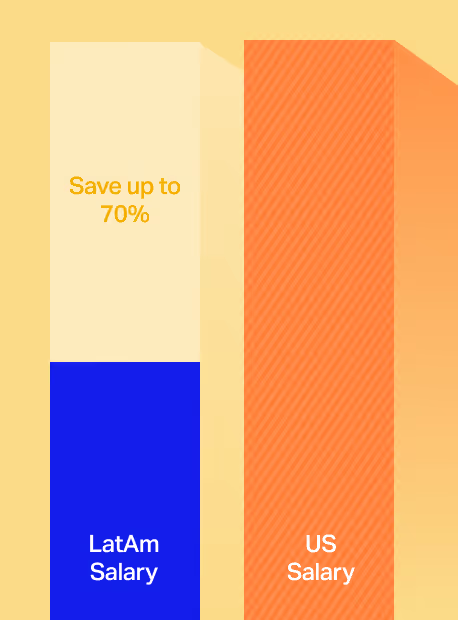
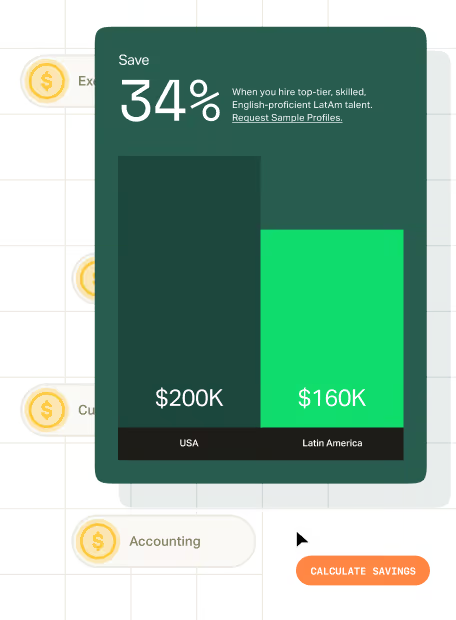
Offshore developer rates run from about $20–$45 an hour in Asia to $80–$150 an hour in the United States and Canada. Hiring a full-time software engineer in Latin America runs $36K–$108K a year against $100K–$238K for the US equivalent.
Where your number falls in that range depends on three things: seniority, specialism, and country. A junior developer in a lower-cost market sits at the low end. A senior specialist in a capital city with US client experience sits at the high end. Most hires land somewhere between those two, and the exact spot depends on which of those three factors your hire needs.
Budget against the specific hire. A senior backend engineer with production experience at scale will not come in at the bottom of any range, in any country.
Offshore developer rates by region
The hourly rates below are the ones most commonly quoted for offshore engineering work, and they all come from the same October 2024 market.us roundup, so the regions are at least measured the same way:
One caveat on these rows, stated plainly so you can judge what you're getting: market.us published these ranges in an October 2024 market news roundup compiled from rates reported on G2, without a stated methodology. They're useful as an illustrative market range, not as a benchmark you'd defend line by line in a budget review.
The Latin America row carries market.us's South America range because Hire With Near's own Latin America figures are annual salaries rather than contract hourly rates. For those, see Hire With Near's IT roles salary guide (US vs Latin America) and the annual table further down this page.
Here's what sits behind each range:
- Asia, particularly India and the Philippines, is the lowest-cost option and the deepest pool for high-volume delivery.
- Eastern Europe sits slightly higher and is well regarded for complex engineering work, with strong pools in Poland and Ukraine.
- Latin America runs close to Eastern Europe on rate while sharing the US working day, which is why it tends to win work that needs live collaboration.
- Western Europe commands premium rates and is usually chosen for regulated or highly specialized work.
- The United States and Canada are the onshore benchmark those savings get measured against.
- Africa is the newer entrant, with Nigeria and South Africa building recognized strength in mobile and fintech development.
For full hourly rates broken out by seniority and country, see our breakdown of how much offshore developers cost.
Full-time engineering hire cost per year
If you're budgeting a full-time engineer, you need annual figures, so here's what hiring engineering talent in Latin America costs against equivalent US hires, according to Hire With Near's salary benchmarks:
For the most up-to-date figures, see Hire With Near's US vs Latin America Salary Guide.
The spread inside each row is the part worth planning around. Hiring a senior engineer in Latin America often costs less than hiring a mid-level US engineer, so these ranges are most useful for determining the level of experience a role requires.
Hire With Near's engineering recruiters consistently see the same thing: hiring at the bottom of the local range ends up costing more later because the person leaves for the next offer.
One US healthtech startup needed senior engineers quickly as demand for its product climbed. It had only two internal recruiters and wouldn't loosen its 8-step interview process to move faster. Working with Hire With Near, the company hired 7 senior engineers across backend, DevOps, QA, mobile, frontend, process, and staff-level roles, kept the full 8-step evaluation intact, averaged 14 days to hire, and cut $323,000 a year against equivalent US salaries.
For more first-party numbers on that side of the equation, see how much US companies save by hiring in Latin America.
What do you give up when you choose the lowest-cost region?
The lowest hourly rate usually costs you working hours, and on engineering work that's the expensive trade. When a team's day starts as yours ends, every question, code review, and blocked ticket waits for tomorrow, and a one-week task can stretch across two sprints.
In the editorial work I do turning what our recruiters know into guidance for hiring managers, this is the friction clients raise most often, and they describe it in hours lost. One engineering leader at a US industrial company running an India-based development team put it in plain terms:
From about two to six in the afternoon our time, there's basically nobody available on the India side. Those are our most productive hours and we just can't get anyone.
That pattern is why companies move. In Hire With Near's analysis on why US companies are hiring in Latin America, with 2,000+ hiring conversations with US companies, 30% were moving away from offshore locations specifically to get workday overlap.
Latin America is the practical answer to that specific problem. An engineer based in the region typically works during US business hours, wherever your team is based, whether you run on Pacific, Mountain, Central, or Eastern time.
Mexico and Central America roughly line up with US Central, and Colombia, Peru, and Ecuador with US Eastern. Argentina, Chile, Uruguay, and Brazil run an hour or two ahead of US Eastern. The exact gap depends on where your team sits and the time of year, since most of Latin America doesn't observe daylight saving time.
The real difference is that the overlap comes without anyone working a night shift. Live standups, same-day answers, and handoffs that happen while everyone is at their desk are all ordinary.
If you're weighing the comparison in more depth, we've covered nearshore versus offshore software development and the questions tech leaders ask about hiring developers in Latin America, and our nearshore staffing page explains how the hiring and employment side works.
Final Thoughts
Start with your review cycle. Write down the engineering work that needs a same-day answer, a live code review, or a decision made in a standup, and you'll know which roles have to sit inside your working day.
With that list in hand, the rate ranges on this page stop being abstract. You're comparing a specific role against a specific working day, which is a comparison a CFO can check.
If you want to work through what that means for a role you're hiring now, book a free consultation to talk through your requirements with our team. We'll walk you through salary benchmarks and the hiring process.
Most of our clients make a hire in under three weeks, whether that's a software engineer in Latin America or, through executive search in Latin America, a VP of Engineering or CTO to lead the team.
{{latam-hiring-cta-v2}}
Frequently Asked Questions
How do I find reliable offshore software developers for my team?
One of the fastest routes to reliable offshore developers is to work with specialized staffing agencies that maintain pre-vetted talent pools and run the technical screening for you.
These agencies match you with developers who have the specific skills you need, whether that's full-stack developers, back-end developers, front-end developers, or mobile developers.
They also handle the compliance and payroll side of hiring internationally, which typically cuts time-to-hire from months to weeks.
What types of software engineering roles can I fill offshore?
You can fill virtually every software engineering role offshore, from DevOps engineers and QA engineers to specialized positions like offshore AI developers, blockchain developers, and machine learning engineers.
Latin America has particularly deep pools for modern stacks, including remote React developers, Python developers, Node.js developers, and remote Angular developers. The deciding factor is whether your partner can reach the specific expertise your roadmap needs.
How long does it typically take to hire offshore software developers?
Working with an established staffing partner, most companies hire an offshore developer in under three weeks from initial briefing to offer acceptance, including sourcing, technical screening, and your own interviews.
At Hire With Near, clients typically see a shortlist in 3 to 5 days. Building an in-house international recruiting function or posting to general job boards usually takes 3 to 6 months instead.
The difference is whether your partner already keeps a pool of pre-vetted software engineers screened for technical skill and English proficiency.
Which countries are the best for offshore software development?
Brazil, Colombia, Mexico, and Argentina are the strongest choices for US companies, while India remains the largest developer pool globally. GitHub's Octoverse 2025 report counts 6.89 million developers in Brazil, now the world's fourth-largest developer community, alongside 21.9 million in India.
Brazil is the largest engineering market in Latin America; Colombia and Peru roughly line up with US Eastern hours, Mexico with US Central, and Argentina runs slightly ahead of US Eastern, depending on your location and the season.
Our guide to the best countries for software development outsourcing compares them in detail.
Do offshore software developers work during US business hours?
Developers based in Latin America typically overlap almost the whole US working day, wherever your team is based, while developers in Asia generally do not.
That gap is the clearest dividing line between nearshore and offshore hiring. An Asia-based team is usually finishing its day as your morning begins, so each round of questions and answers takes a full 24 hours instead of a few minutes.
With an engineer in Latin America, standups, code reviews, and calls happen live, during your business hours, whichever US time zone you run on.
Are software developers still in high demand?
Yes, but demand has concentrated at mid- and senior-level rather than across the board. Federal Reserve Bank of New York data for the second quarter of 2026 put unemployment among recent college graduates at about 5.6% and underemployment at 42%.
SignalFire's State of Talent Report, published in May 2025 and based on data covering more than 650 million professionals, found new graduates now make up just 7% of Big Tech hires, down 25% from 2023, while hiring rebounded for mid- and senior-level roles. Experienced engineers remain competitive to hire.
What are the key trends in offshore software development?
Four trends show up directly in the data on this page: AI inside delivery, cloud data management, low-code adoption, and the shift toward nearshore work.
Deloitte's 2024 survey found 83% of executives using AI as part of their outsourced services. market.us projects low-code and no-code adoption passing 80% within the decade after its October 2024 report, and MarketsandMarkets forecast in April 2023 that cloud data management services would reach $141.2 billion by 2027.
On the nearshore side, the Inter-American Development Bank puts the potential at $78 billion a year in added Latin American exports.
How are offshore software developers vetted technically?
Serious vetting has three layers: a structured technical screen by someone who can read code, a practical assessment tied to the work the role does day to day, and reference checks against production experience rather than job titles.
At Hire With Near, our engineering recruiters screen for hands-on experience with your stack, English fluency for technical discussion, and evidence of ownership in fast-moving teams before a profile reaches you.
You keep your own interview loop and final call. A partner should compress the pipeline, never replace your technical bar.
How good is offshore developers' English for technical work?
Strong enough to run an architecture review, if you screen for it. The bar that matters isn’t conversational English, but whether a developer can explain a design decision, push back in a code review, and write a clear pull request.
At Hire With Near, our engineering recruiters screen Latin American candidates for spoken and written technical English before a profile reaches you, because a senior engineer who cannot articulate a trade-off on a live call slows the whole team down.
Ask any partner how they test for it, and ask to see it on a call before you hire.





.webp)
.webp)



%203.svg)
.avif)





%20(1).avif)

%20(1).png)