.avif)


%203.svg)
Key Takeaways
- Hiring a reliable bookkeeper comes down to three things: clear requirements before you post, a practical skills assessment during screening, and communication evaluated just as seriously as technical ability. Most bad hires skip at least one of these.
- CPA exam candidates have fallen 27% over the past decade. Latin America has become a strong alternative: bookkeepers with Big Four exposure, US GAAP familiarity, and full time zone overlap, at 55–69% less than US equivalents.
- If you need to move quickly or want access to pre-vetted candidates, a recruiting partner that specializes in LatAm finance talent removes the sourcing burden. FinanceWithin cut their time-to-hire from three weeks to seven days after switching to Hire With Near.
Most business owners don't realize how hard it is to hire a reliable bookkeeper until they've already made a bad hire or have been running their own books longer than they should. Inaccurate records pile up quickly: missed tax deadlines, murky cash flow reports, and decisions made on numbers nobody trusts.
Hiring a great bookkeeper can have a massive impact on your business. Accurate books mean better decisions, smoother audits, and fewer financial surprises.
Whether you're bringing on your first bookkeeper or scaling your accounting team, in this guide, I'll cover how to hire a top bookkeeper, including the skills to look for, realistic salary expectations, where to find qualified candidates, and interview questions that reveal true capability rather than rehearsed answers.
What Does a Bookkeeper Do?
Bookkeepers manage day-to-day financial transactions and maintain organized, accurate financial records. Without that foundation, everything downstream, like tax filings, cash flow analysis, and investor reporting, is built on shaky ground.
A bookkeeper's typical responsibilities include:
- Recording daily transactions (sales, purchases, payments, receipts)
- Managing accounts payable and receivable
- Reconciling bank statements
- Processing payroll
- Maintaining the general ledger
- Preparing initial financial statements
- Handling basic tax preparation tasks
The exact scope can vary based on your business size and complexity. In smaller companies, bookkeepers often wear multiple hats, while larger organizations might have specialized roles for different financial functions.
What sets exceptional bookkeepers apart is their ability to go beyond transaction entry. The best ones spot patterns and discrepancies that could signal problems, keep your business compliant with financial regulations, and provide the clean, accurate data needed for strategic decision-making.
That's where the bookkeeper-versus-accountant distinction becomes useful in practice. Accountants focus on financial strategy, compliance, and reporting. Bookkeepers provide the accurate, organized data that makes that work possible. The two roles are interdependent, and a weak bookkeeper creates rework upstream for everyone else.
Small-business consultant Althea Klahr of Marvin and Co. told Entrepreneur that bookkeepers can save businesses 35% in costs compared to using CPAs for routine tasks. The savings come from having the right professional for the right job: Bookkeepers handle day-to-day financial operations while your CPA focuses on higher-level tax strategy and compliance work.
How Much Does It Cost to Hire a Bookkeeper?
The cost of hiring a bookkeeper varies significantly based on experience level, location, and whether you're hiring full-time, part-time, or on a contract basis.
In the United States, bookkeeper salaries in 2026 typically range from $46,000 for junior roles to $74,000 for experienced senior professionals, with mid-level bookkeepers in major metro markets often commanding more. The median sits around $66,500 per year.
It’s not a light cost, as one real estate investor we spoke with described:
It's costing us an arm and a leg to get it done by our current accountants here in the United States... they are a top regional accounting firm, so they're charging top of market rates.
That frustration is common, and it's driving more US companies to look beyond the domestic market for bookkeeping talent.
For many companies, the more useful question isn't just what a bookkeeper costs in the US; it's what the same budget gets you when you expand the search.
For full-time positions, compensation benchmarks show the following ranges for 2026:
*Sources: Hire With Near Salary Guide 2026; Hire With Near's 2026 State of LatAm Hiring Report*
These ranges reflect the increasingly competitive market for financial talent in the US, where demand consistently outpaces supply for skilled professionals.
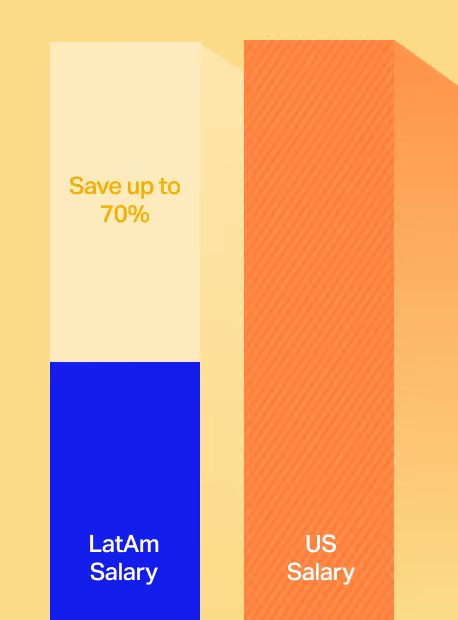
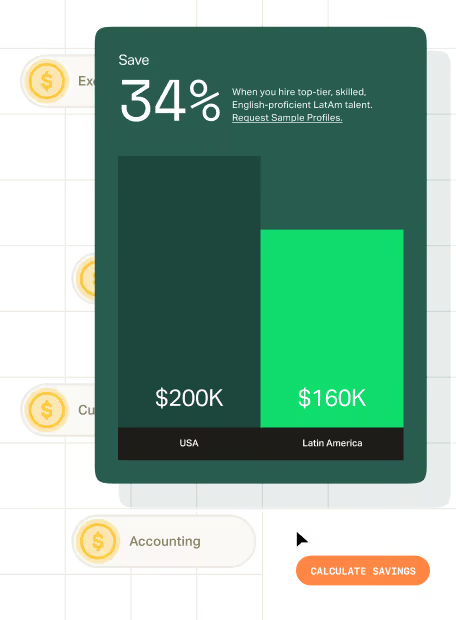
If budget is a factor, hiring a bookkeeper outside the US can reduce costs significantly without sacrificing quality. According to Hire With Near's 2026 State of LatAm Hiring Report, companies hiring bookkeepers in Latin America save $27,000–$66,400 annually compared to US equivalents, a 55–69% reduction. For many businesses, that difference funds a second hire, upgraded tools, or additional finance capacity.
These lower rates reflect different regional economies and costs of living, not lesser talent. In my work sourcing finance and accounting talent for US clients, the depth of the LatAm candidate pool consistently surprises people.
Latin American finance professionals have strong academic foundations and significant Big Four exposure, which gives them direct experience with international accounting standards, including US GAAP and IFRS, among the most common technical requirements I see from US clients.
In Argentina specifically, accounting degrees like the one at the University of Buenos Aires average five and a half years of study (one of the most rigorous accounting programs in Latin America). That academic depth shows up directly in the quality of candidates. Nearly 80% of the bookkeepers and accountants I place come from Argentina and Brazil.
And the seniority level is real: Hire With Near's placement data shows 84% of LatAm hires in 2025 were mid-level or senior professionals.

Further reading: Outsourced bookkeeping cost guide
What Skills Should You Look For When Hiring a Bookkeeper?
The skills that separate strong bookkeepers from unreliable ones break into three categories: hard technical skills (accounting fundamentals, software proficiency, financial reporting), soft skills (communication, organization, problem-solving), and differentiating nice-to-haves like multi-client experience and industry familiarity.
Hard skills
Hard skills are the non-negotiables: technical capabilities your bookkeeper must have from day one.
- Accounting fundamentals: Look for a solid understanding of double-entry bookkeeping, journal entries, and general ledger management. This core knowledge ensures accurate records regardless of which software or systems you use.
- Software proficiency: Experience with modern accounting software is essential. QuickBooks and Xero are the most common, but familiarity with other platforms like FreshBooks, Sage, or Wave can be valuable depending on your setup. If QuickBooks is central to your operations, look for a candidate with QuickBooks expertise (the platform's depth of features means hands-on experience makes a real difference).
- Data entry accuracy: Even small errors in bookkeeping can snowball into significant discrepancies by month-end. Look for candidates who demonstrate meticulous attention to detail in their work samples, assessments, and even their application materials.
- Regulatory knowledge: Your bookkeeper should understand tax filing requirements, deadlines, and basic compliance issues relevant to your business type and location. Familiarity with US GAAP is important for any role touching financial reporting.
- Financial reporting: The ability to produce clear, accurate financial statements (income statements, balance sheets, and cash flow statements) is a baseline requirement. These reports drive business decisions, and your bookkeeper needs to produce them reliably.
Soft skills
While technical skills form the foundation, soft skills often determine how effective a bookkeeper will be in your specific business environment.
- Organization and time management: Bookkeepers juggle multiple deadlines and responsibilities. Those who maintain organized systems and prioritize effectively will keep your finances running smoothly even during busy periods, like month-end closings or tax season.
- Communication skills: Look for candidates who can explain complex financial concepts in simple terms. The best bookkeepers translate numbers into insights that non-financial team members can understand and act upon.
- Problem-solving ability: When financial discrepancies arise, you need someone who can methodically trace issues to their source. During interviews, ask for examples of how they've resolved complex reconciliation problems in the past.
- Adaptability: Bookkeeping tools and regulations evolve constantly. Candidates who show a willingness to learn new systems and procedures will continue to add value as your business grows and changes.
- Discretion and trustworthiness: Your bookkeeper will have access to sensitive financial information. Look for someone with a professional demeanor who understands the importance of confidentiality.
Nice-to-have skills (the differentiators)
These additional skills can set strong candidates apart, particularly for growth-stage companies or businesses in specialized industries:
- Industry-specific experience: Bookkeepers familiar with your industry will understand its unique financial patterns and requirements. This is especially useful in heavily regulated sectors like healthcare or construction. That said, industry knowledge that can be taught is often overvalued compared to stronger core skills. Don't pass on a strong candidate just because they haven't worked in your industry before.
- Technology integration knowledge: Experience connecting accounting software with other business systems (CRM, e-commerce platforms, payment processors) can meaningfully reduce manual data entry and speed up your financial close.
- Financial analysis capabilities: Some bookkeepers go beyond basic record-keeping to surface insights on cash flow trends, profitability by product line, or budget variances. That analytical layer is useful if you don't yet have a dedicated accountant or financial analyst.
- Process improvement expertise: Look for candidates who have streamlined financial procedures in previous roles. Their experience can help eliminate inefficiencies in your close process before they become recurring problems.
- Multilingual skills: For businesses with international clients, vendors, or team members, a bilingual bookkeeper adds real communication value. This is especially relevant if you work with Spanish-speaking partners or clients.
- Multi-client experience: In my work sourcing finance and accounting talent for US clients, multi-client experience is the single clearest differentiator I look for when screening bookkeepers. Candidates who've managed multiple relationships simultaneously know how to communicate with different stakeholders, stay organized under volume, and handle the complexity that comes with serving several clients at once. I'd also prioritize experience with US-based companies. It signals familiarity with US clients and business practices, which shortens ramp-up time considerably.
{{salary-guide-us-latam}}
Where Can You Find and Hire Great Bookkeepers?
Finding the right bookkeeper involves two key decisions: where geographically you want to hire from and which recruiting channels to use.
Local, national, or global talent
Your first choice is the talent pool you're drawing from.
A local, in-office bookkeeper gives you face-to-face access for financial questions, the ability to handle physical paperwork if your systems aren't fully digital, and direct familiarity with local banking institutions. The tradeoff is a smaller candidate pool and US-level compensation in a market where qualified candidates are increasingly scarce.
A remote, US-based bookkeeper opens up the national talent pool without the complexity of international hiring. You get full familiarity with US tax codes and accounting standards, no international payment logistics, and broader candidate choice. Compensation still reflects US market rates.
An offshore bookkeeper expands your search significantly. The same budget gets you more experienced candidates, often with stronger academic credentials than their US equivalents. Latin American bookkeepers in particular offer 55–69% cost savings vs. US rates, full time zone overlap with US business hours, and strong US GAAP familiarity from Big Four-trained backgrounds.
Which region is right for your business?
If you're considering offshoring your bookkeeping activities, for most US businesses, Latin America offers the best balance. You get professionals familiar with US accounting practices who work during your business hours, at 55–69% less than US-based equivalents.
Countries like Argentina, Mexico, and Colombia have strong accounting and finance education systems, and many candidates have direct experience working with US-based companies.
If cost is your primary driver and your workflows are structured around asynchronous handoffs, regions like South and Southeast Asia (particularly the Philippines and India) offer competitive rates. The 9–12 hour time difference limits real-time collaboration to early mornings or evenings, so this model works best for batch-processing tasks with no same-day turnaround requirements.
For most US businesses, though, that time zone gap creates friction that compounds over time. One accounting firm owner who switched from the Philippines to LatAm described it plainly: “I think in the long term, I'd rather have somebody in our time zone. That's the biggest issue — just the time. They're working right now... It's midnight. So they're going to work till five, six in the morning. And I think long-term, it's hard for somebody to do that.”
When you're building a bookkeeping relationship, not just covering tasks, that's a real operational constraint.
In the end, the right choice comes down to two questions:
- Do you need real-time collaboration during standard US business hours?
Latin America is the stronger fit.
- Are you prioritizing the lowest possible cost and comfortable with async workflows?
South and Southeast Asia may work.
If you're also weighing the in-house vs. outsourcing decision more broadly, our comparison of in-house vs. outsourced bookkeeping covers the tradeoffs in detail.
Choosing the right sourcing channel
Once you've decided where to focus your search geographically, you need to choose how you'll find candidates. Common approaches include:
- Employee referrals: Often the strongest option. Your existing team understands your environment and knows what a reliable financial hire looks like in practice.
- Job boards: LinkedIn, Indeed, and accounting-specific boards like AccountingFly give you a broad reach, but expect to invest real time in screening and follow-up.
- LinkedIn direct outreach: Effective for targeting candidates with specific credentials, software experience, or industry background. One thing I look for when reaching out to bookkeeper candidates on LinkedIn that most US companies miss: multi-client experience listed on the profile. A candidate who's managed three to five client relationships simultaneously at a prior firm is already organized under volume and used to adapting to different business contexts.
- Recruitment agencies: Particularly valuable for international searches, where local market knowledge and pre-vetted candidate pools reduce your sourcing time significantly.
Each approach has distinct advantages depending on your timeline and budget. For roles requiring specialized financial knowledge, combining channels typically produces the best results. Start with referrals, post on targeted job boards in parallel, and bring in a recruitment partner if those methods don't produce strong candidates quickly.
How To Hire a Bookkeeper: A Step-by-Step Process
A three-stage approach (defining your needs and sourcing candidates, screening and evaluation, then structuring and closing your offer) consistently produces better hires than an ad-hoc process. Here's how to navigate each stage:
Stage 1: Before and during sourcing
Define your specific bookkeeping needs
Before posting a job description, get clear on exactly what you need:
- Part-time vs. full-time: Do you need 10 hours a week or 40? Many businesses start with part-time bookkeeping support and scale up as transaction volume grows.
- Transaction volume: The complexity of your bookkeeping needs correlates directly with your monthly transaction count. A business processing thousands of transactions needs different support than one with a few dozen.
- Industry-specific requirements: Certain industries (construction, healthcare, nonprofits) have specialized bookkeeping needs and compliance requirements. Identify these before you start sourcing, not after.
- Software expertise: If you're committed to specific accounting software, prioritize experience with that platform. But don't overweight this at the expense of core bookkeeping knowledge. A strong bookkeeper can learn a new tool faster than a mediocre one can learn to think.
Craft a job description that attracts quality candidates
Your job posting is your first filter. A vague description attracts a wide, low-quality pool. A specific one attracts fewer candidates who are much more likely to fit.
Be specific about:
- Daily responsibilities: List exactly what tasks the bookkeeper will own: bank reconciliations, accounts payable and receivable, payroll processing, month-end close, so candidates can self-select accurately.
- Required vs. preferred qualifications: Distinguish between must-haves and nice-to-haves. Listing every qualification as required filters out strong candidates who are missing one item but are otherwise excellent.
- Reporting structure: Will they work alongside an in-house controller or CFO, or will they be your primary financial person? This changes who you need significantly.
- Growth opportunities: Strong bookkeepers want to know there's room to expand their scope. If the role has a clear path, say so.
Stage 2: Screening and evaluation
Use practical assessments to evaluate technical skills
Resumes can't tell you how well someone will really perform. Include a practical component in your evaluation. Our recruiters recommend tasks that assess Excel or QuickBooks skills, bookkeeping knowledge, or logical reasoning:
- QuickBooks or software tests: Have candidates complete tasks in the accounting software you use. This verifies proficiency beyond what they claim on paper.
- Sample reconciliation exercise: Provide a bank statement and transaction list with intentional discrepancies and see how thoroughly they identify and resolve issues.
- Financial scenario questions: Present common situations your business faces and ask how they would handle the bookkeeping aspects.
Focus on communication and problem-solving approach
Technical skills alone don't make a great bookkeeper.
Across the bookkeepers and accountants I've screened, communication is the signal I weight most in interviews. You can tell a candidate is exceptional by the way they express themselves: when they give you clear, sharp answers to specific questions and aren't fumbling to get to a point.
That quality, concise and direct communication, is what separates candidates who look good on paper from those who will serve your clients and internal team well.
During interviews, assess:
- How they explain financial concepts: Can they translate accounting jargon into plain language? If they can't explain it clearly to you, they won't explain it clearly to your clients either.
- Their approach to discrepancies: Ask how they've handled errors or unusual financial situations in the past. Look for methodical, systematic problem-solving rather than vague answers.
- Experience with similar businesses: Candidates who have worked with companies like yours will understand your specific financial challenges from day one.
Don't skip reference checks
For financial roles, reference checks aren’t optional:
- Contact previous employers to verify not just employment dates, but accuracy, reliability, and communication style.
- Ask specific questions about how they handled busy periods, complex reconciliations, or software transitions.
- Verify certifications and education claims, especially for candidates with specialized credentials.
Stage 3: Making the offer and closing the deal
Structure your offer competitively
Skilled bookkeeping talent is in high demand. A slow or below-market offer loses candidates you've already invested time screening. Make yours stand out:
- Offer fair compensation: Research current market rates for the experience level and location you're targeting. An offer below market rarely closes.
- Highlight growth potential: Strong bookkeepers want to expand their skills and responsibilities over time. If the role has a path, make it explicit.
- Consider flexible arrangements: Many excellent bookkeepers value schedule flexibility or remote work options alongside compensation.
Beyond salary, we consistently see that paid time off and observance of local holidays are the perks that carry the most weight for candidates once base compensation is settled.
Speed also counts. According to a Gallup survey, time between applying and receiving an offer was the second most important driver for accepting an offer, only after interview experience. A drawn-out process loses candidates to faster-moving employers.
Prepare for a smooth onboarding
Once your offer is accepted, set your new bookkeeper up properly from day one:
- Document access procedures and security protocols for all financial systems before their start date.
- Schedule structured training on your specific business processes, not just a system walkthrough.
- Establish clear expectations for reporting cadence and communication channels.
- Build a 30/60/90 day plan with specific milestones so both sides know what success looks like.
This preparation protects your financial operations during the transition and shortens the time to full productivity.
{{state-latam-hiring}}
Interview Questions That Reveal the Right-Fit Bookkeeper
Asking the right questions is what separates a productive interview from one where both sides leave with a good feeling but no real information. The five questions below are designed to reveal how a candidate works under pressure and handles real financial problems, not just how well they prepare for interviews. Each question is followed by what a strong answer looks like.
“Walk me through how you would reconcile a bank statement with several unexplained discrepancies.”
This reveals their methodical approach to problem-solving and attention to detail. Strong candidates will describe a step-by-step process, mentioning how they would document unusual items, check for patterns, and implement controls to prevent future discrepancies.
“Describe a time when you identified and corrected a significant accounting error. How did you find it, and what steps did you take?”
This question evaluates both technical knowledge and integrity. Look for candidates who show thoroughness in tracking down the source of errors and transparency in how they communicated the issue to their manager, controller, or other affected team members.
“How do you stay current with changes in accounting standards and tax regulations?”
Regulations and best practices evolve. The best candidates will discuss specific resources they use for professional development, whether industry publications, continuing education courses, or professional associations.
“How do you prioritize your work during busy periods like month-end or tax season?”
This question assesses time management and organizational skills. Strong bookkeepers will explain specific systems they use to manage competing deadlines while keeping accuracy, such as checklists, calendar blocking, or other productivity methods.
“What accounting software have you used, and how would you approach learning a new system?”
Rather than just listing software names, look for candidates who explain their adaptability and learning approach. Great bookkeepers understand the underlying accounting principles that transcend specific platforms, allowing them to quickly master new tools.
For additional questions, see our “10 Effective Interview Questions for Remote Accounting and Finance Professionals” guide.
Common Mistakes to Avoid When Hiring a Bookkeeper
Most hiring mistakes in bookkeeping don't happen during the interview. They happen before it. Unclear requirements, rushed screening, and the wrong evaluation criteria all lead to hires that look fine on paper but create problems within the first quarter.
Here are the five most common ones and how to avoid them.
1. Underestimating the expertise required
One of the most costly mistakes is assuming bookkeeping is essentially data entry. Modern bookkeepers need to understand accounting principles, tax regulations, and financial reporting. Without that foundation, you end up with someone who can operate the software but can't catch errors, flag compliance risks, or produce reports you can actually rely on.
Always verify that candidates have substantive accounting knowledge, not just familiarity with the tools.
2. Rushing the vetting process
Financial roles require thorough screening. Cutting corners here creates downstream problems:
- Errors in your financial records that take months to untangle
- Missed tax deadlines or compliance gaps
- Security exposure with sensitive financial data
The investment in careful vetting pays off quickly. A bad bookkeeping hire typically costs more to fix than it saved in time during hiring.
3. Focusing too heavily on software experience
Software proficiency is important, but overemphasizing experience with specific platforms causes you to screen out strong candidates. A bookkeeper with solid accounting fundamentals can learn new software. The opposite isn’t always true.
Rather than requiring years of experience with a particular program, look for candidates who demonstrate adaptability and a track record of picking up new systems. Consider offering software training to an otherwise excellent candidate.
4. Neglecting communication skills
A bookkeeper who can't clearly explain financial concepts or raise concerns appropriately creates problems regardless of their technical ability. During interviews, pay attention to how candidates communicate complex information and whether they can adjust their explanations based on who they're talking to.
Your bookkeeper will interact with non-financial staff, vendors, and sometimes clients or investors. How they communicate directly affects how well the rest of your team can work with financial information.
5. Overlooking cultural fit and work style
Bookkeeping doesn't happen in isolation. Your financial hire needs to work effectively within your team and adapt to how your business operates. During the interview, assess:
- How they handle tight deadlines and pressure
- Their preferred communication style and frequency
- Their approach to asking questions and seeking clarification
- Their level of proactivity versus needing detailed direction
Finding someone who fits your work culture leads to better retention and more effective offshore bookkeeping across departments.
When I'm screening bookkeeper candidates, the red flags I watch for consistently come down to a few things: a resume pattern showing frequent short stints, poor English in the interview, answers that lack conciseness, and obvious typos on the resume.
I also pay close attention to motivation. A candidate whose main (or only) reason for seeking a change is salary, with no deeper driver, tends not to be a long-term fit. The strongest candidates can explain why they want this role specifically, not just why they're leaving their last one.
{{prevetted-banner}}
How Working With a Recruiting Partner Makes a Difference
While you can certainly hire a bookkeeper independently, working with a specialized recruitment partner offers distinct advantages when you want access to global talent pools or need to move quickly.
FinanceWithin, a fractional finance services firm based in Austin, Texas, faced exactly this situation. They needed to hire multiple senior bookkeepers quickly as client demand grew, but their previous offshore recruitment efforts in India produced high turnover and inconsistent quality. After switching to Hire With Near, they reduced time-to-hire from three weeks to seven days, saved $535,000 annually (a 64% reduction vs. US-based hires), and hired multiple bookkeepers within days to support 10 new client engagements at once.
Miles Eggart, COO of FinanceWithin, described the overall impact:
Partnering with Near has been a major win. The speed, the talent pool, and the overall quality have not only met but actually raised our hiring expectations.
Hire With Near's finance and accounting practice focuses specifically on these roles, which makes the pre-vetting sharper than a generalist recruiter can offer. The most significant advantages of working with a recruiting partner include:
- Specialized candidate assessment: Recruiting partners who focus on financial roles have developed screening methods that evaluate both technical skills and soft skills like communication and problem-solving. Their process gives you a more reliable picture of a candidate's capabilities than a resume and a couple of interviews typically can.
- Access to pre-vetted talent: Rather than starting from scratch, recruiting partners connect you with candidates who have already cleared initial qualification screens. One operations manager at a beauty supplement e-commerce company told us: “Once a candidate comes from Hire With Near, we know they're definitely worth looking at. This is generally not the case for all outsourcing companies.” Their team saved $26,000 annually and hired five times faster than their previous process.
- Guidance on compensation: If you're hiring from a global talent pool, determining competitive pay by region can be difficult. Recruiting partners have current market data and can help you structure offers that attract strong candidates without overpaying. For a full breakdown of provider options, see our guide to the best bookkeeping outsourcing services. CPA firms can also browse our list of outsourced bookkeeping providers for CPA firms.
- Handling international logistics: Hiring internationally involves navigating different payment systems, contracts, and compliance requirements. Specialized recruiting firms have established processes for managing these details, so you can focus on finding the right fit rather than the paperwork.
For most businesses, the reduced time-to-hire, higher quality matches, and lower turnover risk more than offset the cost of working with a partner.
Sheena Malson, Director of Accounting at FinanceWithin, added:
When we saw candidate quality, it became clear these were truly top-tier professionals, better than what we found independently.
Final Thoughts
Knowing how to hire a bookkeeper takes more effort than most business owners expect, but the framework is straightforward: define your needs precisely, assess practical skills rather than just credentials, and evaluate communication alongside technical ability.
If you've decided to expand your search to Latin America, the talent is there. Bookkeepers with strong US GAAP familiarity, full time zone overlap, and 55–69% cost savings compared to US equivalents are available and actively placed by Hire With Near every week.
The fastest way to see whether this is right for your business is to look at actual candidates. Request sample profiles of pre-vetted bookkeepers to see their experience, credentials, tools, and English proficiency level. No meeting required. No commitment. Just real examples of the talent we place every day.
Frequently Asked Questions
Is outsourcing bookkeeping better than hiring someone in-house?
For most small businesses, outsourcing is the more cost-effective option until your transaction volume justifies a full-time hire. If your books require less than 20 hours per month, outsourcing typically costs less and gives you access to more experienced professionals than you could afford full-time.
That said, if you need daily financial oversight or want someone embedded in your team, hiring a dedicated bookkeeper, either in-house or remote, can be a better long-term fit.
See our guide on outsourcing bookkeeping for more about the benefits and some top outsourcing destinations to consider.
Can I hire an offshore bookkeeper and still stay compliant with US tax laws?
Yes, absolutely. Many offshore bookkeepers, especially those based in Latin America, are highly trained in US GAAP standards and familiar with tax filing requirements for US-based businesses.
The key is choosing candidates with prior experience supporting US clients and making sure there is clear communication between your bookkeeper and your CPA or tax adviser.
Why is hiring accounting and finance talent in Latin America becoming so popular?
US companies are increasingly turning to Latin America for accounting and finance roles because it strikes the ideal balance between cost savings, time zone alignment, and talent quality.
Professionals in the region often have strong educational backgrounds, experience with US clients, and deep familiarity with tools like QuickBooks, Sage, and Xero.
Nearshoring to Latin America also enables real-time collaboration without the cultural or scheduling challenges that can come with hiring in more distant regions.
Further reading: Nearshoring: The Smartest Way to Cut Costs & Scale Your Business in 2026
How do I evaluate a bookkeeper's skills before hiring them?
The most reliable way to evaluate a bookkeeper is a practical skills test. Include a bank reconciliation exercise, a QuickBooks task, or a sample scenario specific to your business.
Resume claims alone don't reveal accuracy or attention to detail. A candidate who sails through a test showing methodical problem-solving and clean output is worth far more than a polished resume with no verification behind it.
What's the difference between a bookkeeper and an accountant?
Bookkeepers handle day-to-day financial recording: transaction entry, bank reconciliations, accounts payable and receivable, and payroll processing. Accountants analyze that data, prepare tax filings, and provide strategic financial guidance. For most small businesses, a skilled bookkeeper covers 80% of ongoing finance needs. A CPA or accountant is then brought in for tax strategy and year-end reporting.
How long does it take to hire a bookkeeper?
Through a direct search, most US companies spend four to eight weeks from job posting to accepted offer, accounting for sourcing, screening, interviews, and reference checks. Working with a specialized recruiting partner shortens that significantly.
FinanceWithin reduced their time-to-hire from three weeks to seven days after switching from independent LinkedIn recruiting to Hire With Near's pre-vetted candidate pipeline. In our experience across 139 finance and accounting placements, the most time-sensitive hires (where a client had an immediate need) received first candidates within three to five business days.


.webp)




.webp)


%203.svg)
.avif)





%20(1).avif)

%20(1).png)